
Showing posts with label inquiry. Show all posts
Showing posts with label inquiry. Show all posts
Friday, 15 November 2019
Inquiry: Talk With Michal
Yesterday, we were visited by a lady named Michal. She is the owner of a small business by the name of Foodprint. Foodprint is a business that allows people to purchase food that would've been thrown away at a much cheaper price. You simply download the app, look through the foods, and pick it up. Michal visited us to talk about her business, and how businesses start as this is our Inquiry topic for term 4, Economics and Enterprise. Foodprint has been a business for 6 months, although it has been an idea for 2 years. Michal has for a long time thought about how much food is wasted, and this problem gave her the idea. Did you know that 20 million loaves of bread is wasted in NZ a year! I would recommend that you consider Foodprint as it is literally free money for the same fresh food you can get in a shop! Around 250 cafes supply Foodprint with the food they sell, so you can get a large variety of the foods you like to eat.


Friday, 1 November 2019
Inquiry: Research Time
This week for inquiry, we were given a small challenge to complete. In this challenge we learnt the definitions of a need and want, the difference between them, how have they been met through a product or service, and how do we know when someone needs or wants something. With this knowledge we needed to get into small groups and create a DLO that fully explained everything we learnt. For this activity I worked with Alex, Te Pounamu, Joseph and Jonathan.
Wednesday, 16 October 2019
Inquiry: Early Maori Enrerprise
This week for inquiry, we have started our term focus about Economics and Enterprise. For today's and yesterdays challenge, we learnt about early Maori enterprise throughout New Zealand, and transferred that information over to our devices in only 5 sentences. Once we had our five sentences, our challenge was to convert the sentences to have only 10 syllables per sentence. It was quite the challenge, although I along with my peers Alex, Aung Naing, Te Pounamu and Nevaeh managed to get the job done.
Original 5 Sentences
Early Maori Enterprise started with tribes trading items all over New Zealand. Trades included a variety of foods, baskets and jewellery. Later on British travellers came to New Zealand asking for food, and other items. This turned into trades where the Maori people sold their valuable land and foods for unfair returns. This resulted in the Maori people selling too much of their land and belongings, leaving them with little to nothing.
10 Syllable Per Sentence 5 Sentences
Maori enterprise started with trading. They traded items like food and clothing. Soon British travellers came wanting food. The British also wanted to buy land. Then Maori sold too much, they lost their land.
Tuesday, 28 May 2019
Inquiry: Bus Stop Activity
This week for inquiry, we have started a new rotation. To start off we have had a bus stop activity to complete. The point of this activity was to activate our prior knowledge, and to build it. Prior knowledge is what you already know, and to build it is to expand your knowledge. Because our topic is space, our questions were What do we know about science, What do we know about space, How does space affect us on earth, What do you know about the planets in our solar system, What do you know about the moon, What do you know about the sun, and finally What words do you know that are associated with space. For this task, Learning Space 2 collaborated with Learning Space 1, and we have all enjoyed it.
Monday, 27 May 2019
Inquiry: Growth Science Experiment
Today, we had our second session of science with Mrs Wells from Tamaki College. In today's lesson, we continued on our experiment with beans. In our experiment, we have used different items to mix with soil to see how it would affect the growth of the bean plant. The fertilizers we are using are Mandarins - Mrs Wells, Tea Leaves - Nyjah, Foam Soap - Me, Crushed chocolate - Giovanni, Salt - Victoria, Mashed Potatoes - Julian, Pear skin - Mele, Peanut Butter - Alex, and Pencil shavings - Fui. The method we are following is, Get an ice cream container, Put on gloves, Get a scale, Place empty container on scale, Get soil from junior garden, Measure 40g of foam soap, and place into ice cream container, Measure 400mls of soil that goes into the ice cream container into the beaker, Use hands to stir and mix fertilizer and soil for 1 minute, Label your containers, Measure 200mls of soil and place into 1 pot, and another 200mls into another pot, Mark 3 cm from the tip of your finger, Push your finger into the middle of the soil, Place 1 bean seed (Phaseolus vulgaris) into the hole, Cover the seed with soil, Water with 20 mls of water every Monday Wednesday, and Friday for two whole weeks.
What we have done today, is mix the fertilizer and soil together, we have added the beans, and for the next 2 weeks, we will be watering the plants, and seeing the result of the soil and fertilizer. We would like to say a big thank you to Mrs Wells for coming in to do this experiment with us, and we are looking forward to seeing the end results.

Friday, 24 May 2019
A Visit To Stardome
Yesterday night, Learning Space 2 were given the opportunity to visit Stardome where we could learn about stars, planets, and constellations. We went in a bus, and when we arrived we got to look around the building. First we entered the dome where we met our show presenter Tobias. While in the dome, we got a proper look at how constellations work, and we got to learn about the different opinions on what the constellations make up. We got to see close up what Jupiter and Saturn really look like, and we found out that sometimes the rings of Saturn seem to have disappeared, although it is only the angle of which the rings are facing us. Some facts that we learnt were that Jupiter has 67 known moons, that the rings of Saturn are actually tiny ice moons and dust, and that the stripes on Jupiter are actually storms that are spinning at a rate of 100km per hour. I along with my class had a lot of fun at Stardome, and we are very thankful for the opportunity.


Monday, 20 May 2019
Inquiry: Growth Science Experiment
Today Alex, Nyjah, Julian, Victoria, Mele, Giovanni, Fui and I took part in a science lesson from Mrs Wells from Tamaki College. In the lesson, we have started a science experiment that we will work on for the next few weeks. In the experiment, all of us will be using a different type of fertilizer to see the affect in growth on a bean plant. The fertilizers we will be using are Coffee grounds - Mrs Wells, Tea Leaves - Nyjah, Foam Soap - Me, Crushed candy - Giovanni, Salt - Victoria, Mashed Potatoes - Julian, Pear skin - Mele, Baked beans - Alex, and Pencil shavings - Fui. We would like to give a very large thank you to Mrs Wells for visiting us today, and we are very excited to continue on the experiment.


Thursday, 11 April 2019
Inquiry: Continents Of The World
Today we have been given an interesting challenge by our teacher. This challenge was to create a DLO in ten minutes about the different continents in the world, and the countries that live among those continents. Once we had created the DLO, we then could find at least 3 interesting facts about the different continents. The reason as to why we did this challenge was to expand our general knowledge about the world and different continents. For this activity I worked with Joseph and we had a lot of fun finding facts, and finding information.
Friday, 5 April 2019
Inquiry: North Island Kokako Infographic
This week, everyone in LS2 has been given a set of different challenges based on our camp. For this activity, what we needed to do was find different bits of information about the North Island Kokako bird. This included it's diet, habitat, appearance, and interesting facts. Once we had all of our information, we needed to find a picture, and put it on. This activity was a lot of fun, and my favourite part was drawing a Kokako.


Friday, 15 March 2019
Inquiry: DARE | Impact Message
This term, our focus for inquiry is DARE. It is a program that allows children to learn the dangers, and consequences of drug and alcohol use. Yesterday, Constable Cyrus came into our class to give us extra information about the use of them. We want to give a big thanks to Constable Cyrus for going out of his way to help us. This week, our challenge to alert others about these dangers was to create a DLO that showed what could potentially happen as a result of using drugs or alcohol. For this task, I worked with Alex and Julian, and we created a poster warning people about the dangers of drunk driving. On our DLO's we needed a strong message that would persuade people to think twice about driving drunk or using drugs. Our message was "Don't be like this guy, make a choice... Make the right choice..." We thought this was a strong message, and would work well.


Wednesday, 13 February 2019
Inquiry: Role Models And Heroes
This week for inquiry, we have been given a few challenges for us to complete in groups. For this challenge, we needed to create a DLO that showed what a role model and hero is. In my group I worked with Angela, Giovanni Chavda, Nidhi, Alice, Julian, Jayen, and Holly. We all had fun on this activity, and hope we can return to something like it soon.
Inquiry: How To Show That You're A Leader
This week for inquiry, we have been given a few challenges to complete in groups. For this activity, we needed to create a DLO that showed how to be a leader. For this, I worked with Angela, Nidhi, Jayden and Holly. We all had a lot fun in this activity, and we also decided to put a few pictures that we drew into each slide.
Monday, 24 September 2018
Inquiry: Testing Our Spaghetti Bridges
Last week for inquiry, we finally got to testing our spaghetti bridges that we had spent the last few weeks constructing. This task was to be done in a group of four, so everyone got into pairs, and were assigned our remaining two teammates. Sanujan and I almost immediately got into pairs, and were given our teammates Jericho and Te Ponamu. We worked really well together, and managed to construct a 25.5 cm long bridge made of nothing but spaghetti, rubber bands, and tape. The specific type of bridge that we had chosen to do was a truss bridge. Not too hard, although not too simple. We knew that the strongest shape was a triangle, so a truss bridge was a perfect selection as it includes many triangles in the structure. So we went ahead starting construction, and had a lot of fun throughout the journey. Then came testing day. In this test, we would have a bag that we would fill with bricks. After each brick, we would record our data and move on. Your objective was to hold all eight bricks without the structure of your bridge collapsing. After many bricks, my group managed to come up to six bricks. We then placed our seventh brick, and unfortunately, our bridge broke. Our bridge manages to hold six whole bricks without the structure breaking, I was truly blown away by how well it managed to be. This was such a great challenge for all of us.


Tuesday, 4 September 2018
Inquiry: Using Virtual Reality To Learn
Today, a group of researchers from the Augmented human lab at the University of Auckland, visited our classroom to use virtual reality to teach us about the history of our local Panmure Bridge. Yvonne, and her team brought with them numerous VR Cardboard's, and a few Magic Windows. Although sadly not everyone got to experience everything, but before any of us got to jump into the wonders of virtual reality we all had to do a few tests. These tests involved tests for our eyesight, our balance, and more. One of the tests in particular was based around our knowledge. We had to (Without researching) answer a few questions based around our Panmure Bridge. Although we did not work alone. Everyone had been put into table groups, and we would work together to solve problems, and dive into the depths of Virtual learning. Right after we finished our tests, we finally got into the land of virtual reality. My group started off by using a few iPads to learn about both how the construction of the bridge went, and how letters were sent before the bridge existed. This activity lasted for at least 10 minutes, and involved a whole lot of entertainment. Once completed, we would then revisit the tests that we had done before, and would redo it now that our brains had been refreshed with knowledge. We all had a lot of fun doing these exercises based around the technology of virtual reality. I give a big thanks to Yvonne and her team for the effort they had put into this. They have all done a good job, and I hope that one day they will return.


Thursday, 30 August 2018
Inquiry: Comparing Bridges
During our inquiry session, we were learning about Bridges, Tunnels and Towers. For this task we were asked make an comparison between the Wynyard Crossing Bridge and The Golden Gate Bridge. I worked collaboratively with Sanujan. If you don't know the Wynyard Crossing Bridge is a bascule bridge in New Zealand, and the Golden Gate Bridge a suspension bridge in San Francisco, California. Before we created this Venn Diagram, Sanujan and I had no clue about the Wynyard Crossing Bridge and The Golden Gate Bridge. To be honest we've heard of the Golden Gate Bridge, but never researched deeply about it. So we got to learn many new things.
Inquiry: Alphabet Key
This term, our focus for inquiry has been structures. We have been doing numerous amounts of activities based on this topic, and have all had a lot of fun. This activity in fact was the first one we had to complete. For this activity, everyone would be given a template with labels from A-Z. Our task was to find as many words as we could about structures. With these words, we would put them into the correct sections, and have a session to tell everyone else what we got. This task was to be done individually, and although it was fun, I would've preferred to do it with someone so that we can get twice as many answers.


Inquiry: Types Of Tunnels
This term, we have been focusing on structures as our inquiry. We have been doing many different activities based on this topic, but this one was about the type of tunnels, and the materials they are excavated into. In the process, we found 4 different tunnels. Hard rock tunnels, underwater tunnels, soft rock tunnels, and open cut tunnels. This activity had to be done with a partner, so I worked with Sanujan. We had a lot of fun working together for this task and others, and I hope that next time will be better.
Inquiry: Comparing Different Towers
This term, our inquiry focus has been on structures. We have been doing many activities based around this topic, and this activity was about towers. Our task, was to compare 2 different towers with our well known Sky Tower. This task had to be done in pairs, although we had to choose someone from Mrs Anderson's group to work with. So for this activity, I chose to work with Aung Naing. We had a lot of fun working together for this activity, so I do hope that next time we work together, it'll be twice as fun.


Tuesday, 28 August 2018
Inquiry: Comparing Different Structures
Through out our learning sessions in inquiry we've learnt many things about bridge, tunnels and towers. As you can see Sanujan and I have created a 3 circled Venn Diagram making a comparison between bridges, tunnels and towers. In order to complete this Venn Diagram, Sanujan and I were using our smart searching skills to find information for a particular segment.
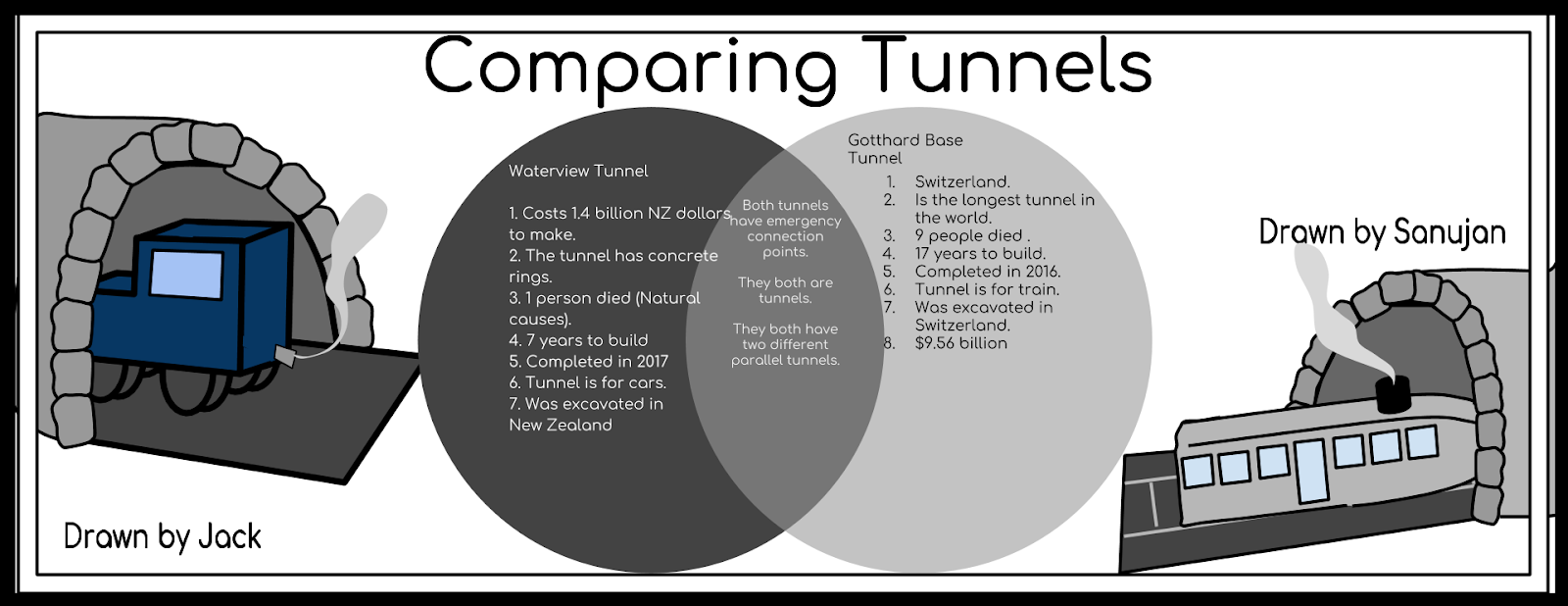
Inquiry: Comparing Tunnels | Gotthard Tunnel and Water view Tunnel
This term, our focus on inquiry has been structures. We have been doing many different activities about this topic, and this activity was based around comparing two different tunnels. The Gotthard tunnel, and the Auckland Waterview tunnel. To compare these tunnels, we in pairs created a Venn Diagram. If you do not know what a Venn Diagram is, basically, you have two circles put together to have 3 circles. One on the left, one in the middle, and one to the right. In the outer circles, you will show the differences between two things, while the similarities will be in the middle. For this task, I worked with Sanujan, and we had a lot of fun researching, and drawing.

Subscribe to:
Posts (Atom)